‘Building Blocks for Peace’
Students
Two Smith College seniors are working on Davis Projects for Peace in Kenya and Bangladesh

A group of Bangladeshi women gather to hear about a Davis Peace Project initiative led by Sagufta Anchal ’27.
Published August 10, 2026
For Sagufta Anchal ’27, peace is possible “when a person can be comfortable in their own body, when it’s not treated as a source of shame.”
For Faithrose Daniel ’27, peace-building is about helping women become economically independent so they are free to make choices about their lives.
The two students are 2026 grantees of Projects for Peace, a program administered by Smith’s Lewis Global Studies Center in partnership with the Davis Foundation. Anchal and Daniel are among some 125 undergraduate students selected this year for $10,000 grants to support summer projects that create “building blocks for peace” around the globe.
Anchal’s project, Menstrual Peace Chains, aims to help women in rural Bangladesh produce their own reusable menstrual pads.
Daniel’s project, Zizinduka: Healing and Harmony through Creative Empowerment, is a 10-week art therapy program for young Kenyan women who have experienced domestic violence and sexual assault.
“Projects for Peace is a wonderful opportunity for our students to explore grassroots community work,” says Caitlin Szymkowicz, associate dean of global education and director of the Lewis Global Studies Center. “To have two projects selected this year is a true delight, and reflects well on the social justice awareness of Smith students.”
While their projects were rolling out in late July, the two Projects for Peace recipients shared some details about their initiatives.
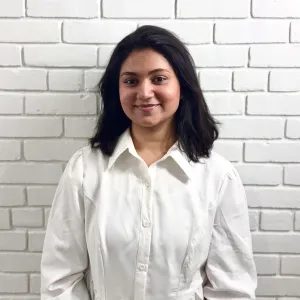
Sagufta Anchal ’27
Biochemistry and statistical and data sciences major
What was the Inspiration for your project?
“In 2024 there was a cyclone in my country [Bangladesh] that affected 3.7 million people. Everything was destroyed. Food, clothing—everything. The [aid organizations] were focused on food and water, but women were also menstruating and there were no supplies. Many girls and women were missing school and work because they didn’t want to go out when they were having their period.
I had been working, when I was in high school, with a nonprofit called Put a Period [PAP, a youth-led initiative for breaking menstrual taboos]. The idea was already in my mind—especially after the cyclone—to go into villages and train women how to make their own pads using clothing scraps. When I saw the peace project [application] I thought, okay, I’m going to apply!”
How is your project going?
“Our team [from PAP] back in Bangladesh has been scouting places and we found a village where we could implement the project. We have trainers and sewing kits and we’ve spoken to about 30 women in the village. I’m really hopeful about this. We will not only teach the women to make their own pads, but we feel like they will teach their kids, their friends—they’ll amplify the message.”
What’s next for you?
“I’ve been working with women’s health for the long term. I feel like I’m going to continue this anyplace that I am. It’s just one of the passions of my life.”
How does your project contribute to peace?
“Peace begins when a person is comfortable in their own body. When one can move, study, and work without apology or shame, even in the midst of climate disruption. That is when peace begins.”
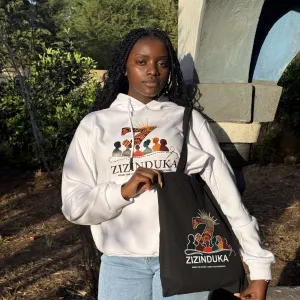
Faithrose Daniel ’27
Statistical and data sciences major
What was the inspiration for your project?
“Growing up in Kenya, I witnessed women and girls in my community experience domestic violence and sexual assault, often without the safety, resources, or emotional support they needed to heal. I saw how survivors were expected to simply move forward, even while carrying trauma, shame, and financial dependence.
Those experiences stayed with me and inspired me to establish [the nonprofit] MamaPower, through which I have continued working with young mothers and survivors of violence. Over time, I realized that shelter and vocational training, while important, were not enough. A woman could learn a practical skill and still struggle to rebuild her life if her emotional wounds remained unaddressed. I wanted to create something that allowed healing and economic empowerment to happen together.
That’s where Zizinduka began. The name combines zizi, meaning ‘roots,’ and zinduka, meaning ‘awakening.’ Together, they represent an awakening from the roots, a process of helping women heal deeply and rebuild their lives.Through art, fabric, color, sewing, and weaving, participants can express experiences that may be too painful to put into words, while also developing skills that can become a source of income.”
How is your project going?
“We are currently working with 25 young women and girls between the ages of 11 and 23 from several refugee homes, including some I had worked with previously [with MamaPower]. We provide the art materials and trained art therapists who guide the participants through the healing and creative processes. Zizinduka is now registered as a nonprofit, and we are also developing a digital shop where the women’s creations can be showcased and sold.
The program will culminate in a community celebration where participants can share their work and community members can have honest conversations about domestic violence: Why does it continue to happen? What can each of us do to prevent it? For me, involving the wider community is essential. If we support survivors without addressing the attitudes and systems around them, they may return to the same harmful environments, and we will not have created lasting change.”
What’s next for you?
“I have always wanted to build something of my own, but more than that, I have always felt a responsibility that whatever I build should open doors for other people too. I think this comes from seeing how many talented women around me have ideas, skills, and creativity, but not always the support to turn those into stable incomes. So even if I end up in finance, technology, or something completely different, I know I will still be building Zizinduka alongside that.
My next step is to take Zizinduka’s digital shop seriously as a real business, not just an add-on. I want the women’s work to be seen and valued beyond the spaces we currently operate in—beyond Kigali, beyond Rwanda, and eventually beyond Africa. My long-term goal is for Zizinduka to generate real, consistent income for the women and for the organization, so that it can last without constantly depending on outside approval or funding cycles.”
How does your project contribute to peace?
“Zizinduka contributes to peace by beginning with the individual. I believe peace is not only the absence of war or conflict; it is also the ability to feel safe in your own body, to speak without fear, to regain control over your life, and to imagine a future beyond what has happened to you. For women and girls who have experienced domestic or sexual violence, that kind of peace can be difficult to reach. Through art therapy, Zizinduka gives survivors a safe and creative way to process those experiences.”